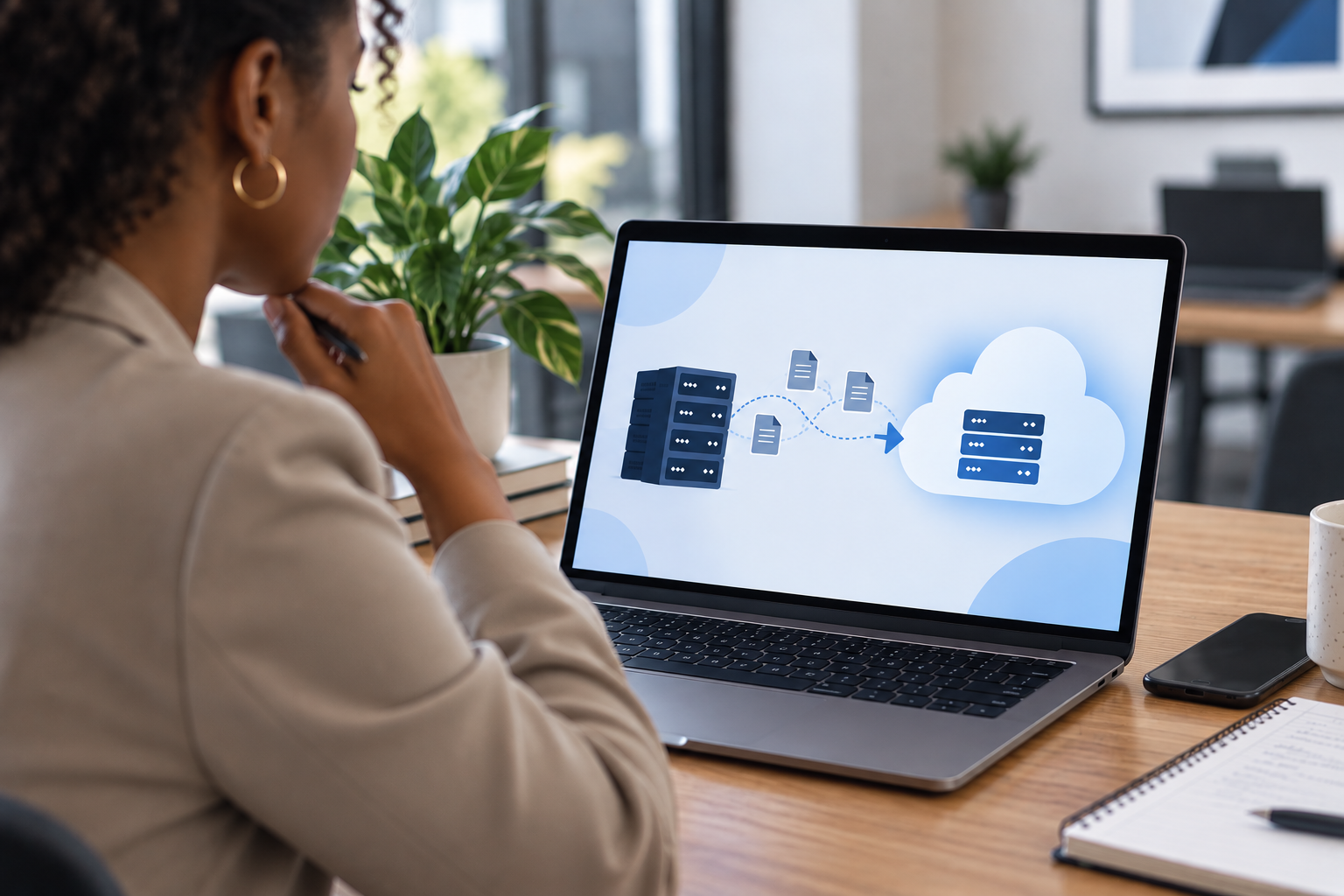
A successful cloud migration depends as much on method as it does on technology
Migrating a connected system to the cloud requires working with the reality on the ground. For 40 years, we have been bridging the gap between physical equipment and digital platforms. We maintain operational control locally to preserve responsiveness, and we leverage the power of the cloud to analyze and process your data.
"We maintain operational control locally to preserve responsiveness, and we leverage the power of the cloud to analyze and process your data."
Our multi-cloud agnostic stance (AWS, Azure, GCP, OVHcloud, Kubernetes) allows us to recommend the environment best suited to your business, taking into account the real-world constraints of your connected equipment, rather than the one favored by a commercial partner. Infrastructure designed without anticipating scaling, or neglected security management, remain the two most frequent risks in this type of project: our Linkers address these during the audit, not as an afterthought.
Then there is the regulatory question, which we integrate from the scoping phase. Migrating data to the cloud directly affects data protection obligations, especially when the migrated system is connected to equipment in critical sectors and therefore falls under the scope of the NIS2 directive.
Cloud environment recommendations that remain vendor-independent
At IT Link, choosing a target environment impacts your company far beyond the IT department: it dictates the budget, regulatory compliance, and future flexibility, often for years to come. Our stance is multi-cloud agnostic, with no proprietary lock-in to any specific provider. This approach also allows us to manage cloud adoption gradually, sector by sector, rather than imposing a one-size-fits-all model.
"Our stance is multi-cloud agnostic, with no proprietary lock-in to any specific provider."
This independence fundamentally changes the decision-making process. A commercial agreement with a single hyperscaler often pushes you toward their own environment, even when it is not the best fit for your needs. We present your teams with several costed scenarios, taking into account your workloads, regulatory constraints (data sovereignty, hosting within the European Union), and the level of vendor dependency you are willing to accept. Each scenario details the benefits, costs, and features available depending on the chosen provider.
This approach applies equally to a first-time cloud migration and to switching providers for an existing environment: the decision-making logic remains the same, only the starting point changes. It also applies to organizations looking to distribute data flows across multiple public clouds to limit vendor lock-in while keeping costs under control.
Data and database migration: the most sensitive part of the project
Data migration accounts for the bulk of the operational risk in any cloud migration project, whether it is a first-time migration or a provider switch for an already hosted environment. A plan that looks solid on paper can fail if the database transfer is not tested under conditions that accurately reflect real-world volume and load.
For older or more complex applications, we rely on a legacy recovery playbook: reconciling data between the old and new environments, running in dual-run mode while validating the switchover, and then performing a gradual migration rather than a single "big bang" cutover. This method limits risk in cases where a complete rewrite would be too costly or risky in the short term, and provides a safety net at every step.
We systematically validate data integrity before and after the transfer using comparative test sets on pre-production servers. Migrations of large or high-traffic databases are generally organized via continuous replication to minimize downtime during the final cutover.
"Migrations of large or high-traffic databases are generally organized via continuous replication to minimize downtime during the final cutover."
Data protection remains a constant requirement at every stage of the transfer, from encryption in transit to access management in the target environment. We integrate these data protection obligations (GDPR) and, where applicable, the requirements of the NIS2 directive into every step of the migration process, even when information passes through infrastructure hosted outside the European Union. This rigor allows us to tightly link technical performance with regulatory compliance, rather than treating the two as separate issues.